domingo, 31 de maio de 2009

sexta-feira, 29 de maio de 2009
[] Antonio Tàpies 'The Resources of Rhetoric' . Dia: Beacon

L’escala (The Ladder), 1974. Mixed media on wood, 98 3/8 x 118 inches (250 x 300 cm). Fundación Telefónica, en depósito en el Museo Nacional Centro de Arte Reina Sofía. © Museo Nacional Centro de Arte Reina Sofía.
http://www.diabeacon.org/bindex.html
'Antoni Tàpies, los recursos de la retórica es el título de la exposición dedicada al artista español que se puede visitar en la Fundación Dia Art Beacon, de New York. La exposición llega como el broche de consagración internacional de uno de los artistas españoles vivos más importantes de la segunda mitad del siglo XX.
¿Qué podremos ver? La muestra reúne 16 obras de Tàpies, cuya eje temático y fuerza se encuentra en la producción matérica de la obra misma.
La propuesta: es mostrar una vez a Tàpies en el circuito del arte estadounidense, lugar en el que tuvo influencia en la década del 60 y luego cayó en desuso por la crítica y el surgimiento del arte conceptual.
Lugar: Fundación Dia Art Beacon, en Riggio Galleries, 3 Beekman Street, de New York. Abierto al público hasta el 19 de octubre próximo'.
Disponível em:
http://mundoarte.portalmundos.com/exposicion-de-antoni-tapies-en-new-york/
quinta-feira, 28 de maio de 2009
[] Versão de Braun-Vega das Meninas de Velasquez

Quadro de Braun-Vega
http://www.braun-vega.com/
'Herman Braun-Vega, inventor de la interpicturalidad, ha llevado a muy alto nivel de perfección su enfoque original, pero sin pontificar nunca: siempre hay cierta dosis de humor en sus cuadros, lo que acrecienta su sabor. Es de esta manera como Braun-Vega nos introduce al círculo familiar de los grandes maestros. Me imagino que su mayor alegría, cuando acceda sin falta al paraíso de los pintores con sus cuadros, será ver a Poussin, Rembrandt, Manet, Velásquez, Cézanne, Picasso, Goya y a otros cuantos artistas de este calibre acercándosele amiablemente para retocar lo que respectivamente les concierne en su trabajo?'
Jean-Luc Chalumeau agosto de 2007
Disponível em:
http://www.resonancias.org/content/read/735/
[] Pancho Guedes no CCB

Ver:
Vamos pôr um crocodilo no telhado?
21.05.2009 - Alexandra Prado Coelho
http://ipsilon.publico.pt/artes/texto.aspx?id=231901
quarta-feira, 27 de maio de 2009
[] Henrik Håkansson
Henrik Håkansson, Broken Forest, 2006. Étude préparatoire (détail de l’installation)
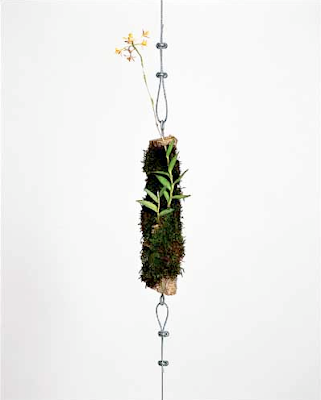

Henrik Håkansson, Broken Forest, 2006. Détail de l’installation au Palais de Tokyo, 08 juin-27 août 2006.
DISPONÍVEL EM:
http://www.paris-art.com/art/critiques/d_critique/zoom/5140/Tropico-Vegetal-Lost-in-Paradise-3429.html#zoom
Disponível em:
http://www.paris-art.com/art/critiques/d_critique/zoom/5139/Tropico-Vegetal-Lost-in-Paradise-3429.html#zoom


Henrik Håkansson, Broken Forest, 2006. Détail de l’installation au Palais de Tokyo, 08 juin-27 août 2006.
DISPONÍVEL EM:
http://www.paris-art.com/art/critiques/d_critique/zoom/5140/Tropico-Vegetal-Lost-in-Paradise-3429.html#zoom
Disponível em:
http://www.paris-art.com/art/critiques/d_critique/zoom/5139/Tropico-Vegetal-Lost-in-Paradise-3429.html#zoom
segunda-feira, 25 de maio de 2009

domingo, 24 de maio de 2009
[] l' ÉPHÉMÈRE . SCHUMANN . Papillons . LIGETI . Glissandi
'Il convient donc de différencier l’éphémère du seul instant comme ‘coupure du temps’ au sens aristotélicien, mais aussi du seul présent vécu. L’éphémère est un art du temps, qui consiste à l’accueillir, à céder au temps (tempori cedere), et à l’accepter tel qu’il est, fût-il imprévisible. Il est beaucoup plus proche de la quête de l’intervalle propre à la culture japonaise do Ma (espacement, intervalle, vide) que la seule jouissance hédoniste du présent qu’il implique. Car tout passage est fugitif et fragile, et rentrer au cœur de l’occasion comme ‘rencontre implique traverser le temps, de lui donner sont rythme, ses aiguillons, ses intensités et ses intranquillités. Une sagesse toute musicale en somme, qui me fait penser aux Papillons d’un Schumann, ou aux vibrations et suspensions sonores des Glissandi de Ligeti. L’éphémère n’est pas le temps mais sa vibration devenue sensible'.
BUCI-GLUCKSMANN, C. (2003). Esthéthique de l’éphèmère. Paris: Galilé.p.26.
BUCI-GLUCKSMANN, C. (2003). Esthéthique de l’éphèmère. Paris: Galilé.p.26.
quinta-feira, 21 de maio de 2009
[] Maarten Vanden Eynde

Maarten Vanden Eynde - rave nature
'Rave Nature was build for the Festival Cement (=concrete), a cultural event that takes place every year in Maastricht. We developed a stage in the ‘Enci-forrest’ near the marl quarry of the Factory Enci. They produce concrete and are the main sponsor of the “Cement Festival”. Their 20 years lasting digging contract causes a lot of problems for the natural environment. The stage could only stay during the Festival. At night the public came by bus and was confronted with a disco lightshow and the pounding rave-song “Move your ass” by Scooter'.
Disponível em: http://www.todayandtomorrow.net/2008/12/12/rave-nature/
Ver mais:
http://images.google.pt/imgres?imgurl=http://www.genetologisch-onderzoek.nl/wp-content/image_upload/penone1.jpg&imgrefurl=http://www.genetologisch-onderzoek.nl/index.php/category/biologie/dendrology/&usg=__jABFG13vSn1uk4OvahTYsYT9EMc=&h=600&w=450&sz=125&hl=pt-PT&start=7&sig2=yKUm5Voyq37hpPjon94vVQ&um=1&tbnid=56cJqZqB716a0M:&tbnh=135&tbnw=101&prev=/images%3Fq%3DPenone%26hl%3Dpt-PT%26client%3Dfirefox-a%26channel%3Ds%26rls%3Dorg.mozilla:pt-PT:official%26hs%3Do0U%26sa%3DN%26um%3D1&ei=HnAVSqi_A8Sx_AbD4aX2DA
domingo, 17 de maio de 2009
[] Museu de Arte Popular . Lisboa
Pela reabertura e renovação do Museu de Arte Popular, em Belém.
http://museuartepopular.blogspot.com/
http://www.flickr.com/photos/rosapomar/3536352681/
http://museuartepopular.blogspot.com/
http://www.flickr.com/photos/rosapomar/3536352681/
sexta-feira, 8 de maio de 2009
[] Hélio Oiticica . Invenção da cor

Hélio Oiticica, Invenção da cor, Penetrável Magic Square # 5, De Luxe, 1977, foto: Carol Reis
Penetrável Magic Square # 5
Disponível em: http://www.inhotim.org.br/arte/obra/view/354
quarta-feira, 6 de maio de 2009
[] ARTIST ROOMS: Sol LeWitt . 12 May – 13 September 2009

Sol LeWitt
Wall Drawing #1136 2004
'Tate Liverpool presents a major wall drawing by influential American artist Sol LeWitt as part of the first UK tour of ARTIST ROOMS, a collection created by dealer and collector Anthony d'Offay and acquired by the nation in 2008. The concept was to devote one room to an artist and show simultaneously in galleries across the UK.
Sol LeWitt (1928-2007) was a pioneer of Conceptual Art and Minimalism. He believed "Ideas can be works of art; they are in a chain of development that may eventually find some form. All ideas need not be made physical".
In 1969, he began to conceive guidelines for two-dimensional works drawn directly on the wall. Over 1,200 of his wall drawings have been executed so far, and his art continues to influence artists and fascinate audiences in various sites across the world'.
Disponível em:
http://www.tate.org.uk/liverpool/exhibitions/sollewitt/default.shtm
quarta-feira, 29 de abril de 2009

domingo, 26 de abril de 2009
[] Charles Long . Whitney Biennal 2008
'Born 1958 in Long Branch, New Jersey; lives in Los Angeles, California
Charles Long’s interest in opposing formal and metaphysical forces informs a complex sculptural lexicon marked by radical stylistic shifts that are difficult to categorize. Incorporating an extraordinarily rich range of media, his process-based sculptures continuously show the artist’s struggle to connect the cosmos to the physical world, inside space to outside, through what the artist describes as the “implosion or explosion” of materials. Though visually the organically shaped sculptures recall the modernist works of Constantin Brancusi, Isamu Noguchi, or Theodore Roszak, their nonrepresentational ambiguity encourages surrealistic interpretive free associations.
The Amorphous Body Study Center (1995), a collaborative project with British pop group Stereolab, and Long’s 1997 Whitney Biennial contribution, epitomizes his colorful, blobby, biomorphic sculptures of the 1990s. Over the past ten years, this anthropomorphic style has mutated into white, gray, and pastel-colored sculptures that are now nearly devoid of Pop references, while still wittily limning the space between abstraction and figuration. Two recent exhibitions at Tanya Bonakdar Gallery in New York and Brown University’s David Winton Bell Gallery demonstrated how Long has elaborated personal life experiences to comment on the human condition and the artist’s ever-evolving definitions of beauty.
Since relocating from New York, Long has mined the Los Angeles River both for materials and as a source of rich meanings. Poem of the River (2005) is a steel armature covered with plaster-coated debris collected from the river basin. Placed upside-down as it dried, its frozen drips of plaster emulate the detritus clinging to river basin trees in the poststorm ruination following heavy rains. Agnes Martin Kippenberger (2005) is a conflated homage to two artists representative in Long’s mind of control versus chaos: from a metal base, several copper poles—“rational supporting elements”—protrude upward to hold skull-like forms cast from cement mixed with riverbed sediment. At Brown University in 2005, these haunted, postapocalyptic works were exhibited with sculptures incorporating bare lightbulbs that enhanced the spectral atmosphere through shadow while emphasizing dynamic shapes and textures. Also created from scavenged river junk and silt, papier-mâché, and plaster over steel armatures, the sculptures in Long’s 2007 exhibition knowirds at Tanya Bonakdar Gallery are his most abject and apparitionlike works to date. Reminiscent of Alberto Giacometti’s frail figures, these pieces are modeled after the great blue heron excrement that streaks the concrete river embankment. Long sees his tall, desiccated ghosts as harbingers of death that paradoxically assert the resilience of life through their inclusion of every imaginable type of refuse. All untitled, these pieces were exhibited alongside framed albumen photographs of the heron droppings to which they allude. Here, Long has arrived at forms that are as concise as his notion that making artwork is both treacherous and life affirming'.
Author: TRINIE DALTON
Disponível:
http://whitney.org/www/2008biennial/www/?section=artists&page=artist_long
Subscrever:
Mensagens (Atom)


![[] Eduardo Kac](http://images.google.pt/imgres?imgurl=http://www.viewingspace.com/genetics_culture/pages_genetics_culture/gc_w03/kac_webarchive/gfp_bunny_page/albagreen.jpeg&imgrefurl=http://www.viewingspace.com/genetics_culture/pages_genetics_culture/gc_w03/kac_webarchive/gfp_bunny_page/gfp_bunny.htm&usg=__P5bQ2hQouNV7f8FkDSRxvgfiQWY=&h=357&w=432&sz=31&hl=pt-PT&start=1&sig2=Rf99g2rwIUp4dGaGW3QV1Q&um=1&tbnid=kB6iIQRufA1LXM:&tbnh=104&tbnw=126&prev=/images%3Fq%3Deduardo%2BKac%26hl%3Dpt-PT%26client%3Dfirefox-a%26channel%3Ds%26rls%3Dorg.mozilla:pt-PT:official%26sa%3DX%26um%3D1&ei=iGjaSbCXIYaQ_Qax-LXwDA)
![[] Pieter Brughel . Queda de Ícaro](http://images.google.pt/imgres?imgurl=http://4.bp.blogspot.com/_va89eTF6-EE/SLnB4SPnc9I/AAAAAAAAAQU/zftsl2Ht-ps/s320/Carlo%2BSaraceni.jpg&imgrefurl=http://lula-gigante.blogspot.com/2008/08/as-quedas-de-caro-anlise-de-quatro_5442.html&usg=___tBtaHa0yw1MyjrD6j_uzbTuhWU=&h=246&w=320&sz=20&hl=pt-PT&start=43&sig2=setWLx8Y8TFR4H3kwCA-rA&tbnid=w6AWGvjCfqxS1M:&tbnh=91&tbnw=118&prev=/images%3Fq%3DBrughel%2Be%2Ba%2Bqueda%2Bde%2Bicaro%26gbv%3D2%26ndsp%3D21%26hl%3Dpt-PT%26client%3Dfirefox-a%26rls%3Dorg.mozilla:pt-PT:official%26sa%3DN%26start%3D42&ei=qMxNSpK-Ms6D-Qapken-Aw)